
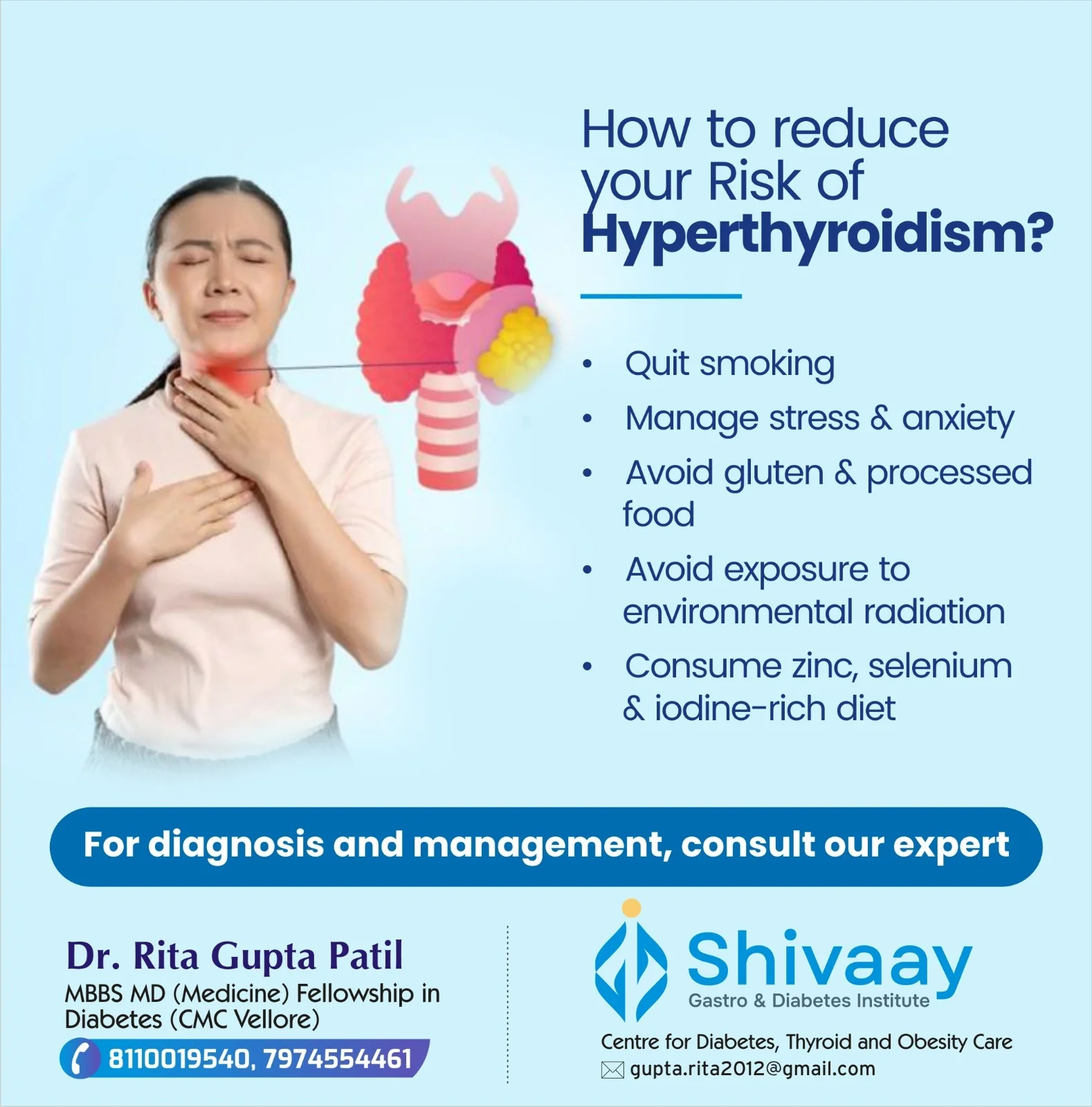
Hyperthyroidism Treatment in Indore – Symptoms, Risk Factors, Diagnosis & Thyroid Care
Hyperthyroidism is a condition in which the thyroid gland produces more thyroid hormones than what the body needs. Thyroid hormones affect metabolism, heart rate, body temperature, energy levels, digestion and numerous other functions. This is why too much hormone production can impact many parts of the body at the same time.
If you have symptoms like unexplained weight loss, rapid heartbeat, excessive sweating, nervousness, tremors, heat intolerance, or sleep problems, consulting a qualified doctor for Hyperthyroidism Treatment in Indore can help you find the cause and start appropriate management.
Shivaay Gastro & Diabetes Institute provides evaluation and management support for thyroid related concerns in Indore. Dr. Rita Gupta Patil provides consultation for diabetes, thyroid and obesity related conditions.
Hyperthyroidism, or an overactive thyroid, is when the thyroid gland produces too many thyroid hormones. The thyroid is a small, butterfly-shaped gland that sits at the front of the neck, but its hormones affect many processes throughout the body.
If thyroid hormone levels get too high, the body’s normal processes may speed up. This can cause symptoms that affect the heart, digestion, muscles, mood, sleep, weight and menstrual cycle.
If you are looking for a Thyroid Specialist in Indore then do not rely on the symptoms only but get yourself checked medically as many other health issues can mimic the same complaints.
“Symptoms can really vary from person to person. Some patients report numerous changes, while others may have relatively mild symptoms.
Common symptoms may include:
• Losing weight without effort • Irregular or rapid heartbeat • Excessive sweating
• Intolerance to heat
• Hand tremor or shaking
• Nervousness or irritability
• Anxieties
• Sleep problems
• Increased appetite
• Weakness muscles
• Regular bowel movements
• Tiredness
• Thyroid gland enlargement
• Changes in your periods
• Exercise tolerance is reduced
If you have symptoms that don’t go away, it’s important to see a doctor as hyperthyroidism can cause serious complications if left untreated.
There isn’t one cause of an overactive thyroid.
Graves’ disease is an autoimmune disorder and a common cause of hyperthyroidism. With Graves disease, the immune system makes antibodies that stimulate the thyroid gland to produce too much thyroid hormone.
Certain thyroid nodules are able to produce thyroid hormones independently. These are known as toxic adenoma or toxic multinodular goiter.
Sometimes , inflammation of the thyroid gland causes stored thyroid hormones to leak into the bloodstream , which will temporarily cause symptoms of hyperthyroidism .
In susceptible individuals, large amounts of iodine can precipitate or aggravate hyperthyroidism. Some supplements, seaweed products, medicines or other sources may contain iodine.
Some medicines can influence the thyroid gland. For example, iodine-containing medicines such as amiodarone can sometimes cause an overactive thyroid gland.
Not all cases of hyperthyroidism are preventable. Autoimmune diseases such as Graves’ disease, thyroid nodules and genetic predisposition are not completely in a person’s control.
But some habits can help minimize avoidable risk factors or complications.
There has been an association between smoking and increased risk of Graves’ hyperthyroidism, especially in relation to thyroid eye disease.
If you already have Graves' disease, it is even more important to quit smoking because smokers are more prone to developing thyroid eye problems.
Before I go any further I want to correct a misconception I hear often . Taking extra iodine is NOT a general way to prevent hyperthyroidism .
In vulnerable individuals, an excessive intake of iodine can actually provoke or worsen the condition. Those who have Graves’ disease or other autoimmune thyroid disorders are more sensitive to high doses of iodine.
So don’t start taking iodine supplements for thyroid health without consulting a professional.
If you are taking medications that are known to contain significant amounts of iodine or that can affect thyroid function, talk to your healthcare professional about appropriate monitoring instead of stopping prescribed treatment on your own.
Those with a past history of thyroid problems, thyroid nodules, autoimmune thyroid disease or other risk factors may want to consider appropriate testing of the thyroid based on a medical recommendation.
Stress can exacerbate feelings such as anxiety, palpitations, sleep disturbance, and irritability . Symptoms may overlap with hyperthyroidism . But stress management alone should not be viewed as a treatment or a surefire way to prevent an overactive thyroid.
“If the symptoms continue, it’s more useful to check thyroid hormones than to blame it all on stress.
There is no blanket advice that everyone should avoid gluten to prevent hyperthyroidism.
Restrictive diets are usually prescribed by a medical professional and are designed around one’s medical condition and nutritional needs. You don't need to cut out whole food groups and it can make it harder to eat a well-rounded diet.
For major changes in diet, one going for Hyperthyroidism Treatment in Indore should consult his treating doctor or a qualified dietitian.
Zinc and selenium are nutrients important for normal body functions and selenium has roles related to thyroid hormone biology. But just because a nutrient is important to thyroid physiology does not mean that supplements are necessarily helpful.
High-dose supplements are unnecessary unless you have a documented need and in some circumstances they can be harmful.
A well-rounded diet is generally best unless a specific nutritional need is identified by testing or medical evaluation.
A doctor may consider symptoms, medical history, medications, family history and thyroid examination before recommending laboratory tests.
Common investigations include:
• Thyroid stimulating hormone (TSH) • Free T4 “ • T3 levels. • Thyroid antibodies, as indicated • Selected cases for thyroid ultrasound
• Additional thyroid imaging as indicated clinically
Low TSH with high thyroid hormone levels are often useful in supporting the diagnosis, but the tests should be interpreted according to the individual patient.
Too much thyroid hormone can cause a fast heart rate and can cause palpitations or an irregular rhythm.
That’s why racing heart symptoms that don’t go away shouldn’t be dismissed.
Older patients or those with pre-existing heart disease, in particular, may require evaluation of their cardiovascular symptoms in addition to treatment of their thyroid disorder.
A common symptom is unintentional weight loss because excess thyroid hormone can speed up metabolism.
Some people can even eat more than usual and still lose weight.
If you lose weight for no good reason, your doctor may check your thyroid as part of the work-up.
Sometimes an overactive thyroid can cause:• Agitation
• Irritable
• Nervousness
• Trembling
• Heart racing
• Difficulty sleeping
They might look like anxiety disorders. Therefore, if the symptoms are not explained or if there are other signs of hyperthyroidism, it may be appropriate to test for underlying physical conditions such as thyroid dysfunction.
Treatment is based on the cause, severity, age, general health, pregnancy, size of the thyroid, symptoms and other individual factors.
Treatment options include: *Standard
These drugs reduce the ability of the thyroid gland to make thyroid hormones.
Some medicines may be given to help control symptoms such as a fast heartbeat, tremors or palpitations until the thyroid problem is treated.
In selected patients, radioactive iodine can be used to destroy overactive thyroid tissue. It is used in some cases of Graves' disease and toxic thyroid nodules.
In selected cases surgery can be considered. The usual treatments for Graves’ disease are antithyroid drugs, radioactive iodine and surgery.
If you have constant : Talk to a professional for an evaluation.• Fast heartbeat
• Weight loss for no reason
• Shivers
• Excessive sweating
• Heat intolerance
• Neck enlargement
• Anxiety or irritability that persists
• Severe sleep disruption
• Fragility
• Irregularities of menstruation
Severe sudden symptoms, including marked palpitations, chest discomfort, severe shortness of breath, confusion or a very high fever, require immediate medical attention.
1. Is Hyperthyroidism curable?
Hyperthyroidism is treatable, but the optimal treatment depends on what is causing it. Treatment may include medication, radioactive iodine, surgery, or a combination of approaches.
2. Should hyperthyroid people take extra iodine?
Not without the advice of a doctor. In some people, especially those with certain thyroid problems, excess iodine can cause or worsen hyperthyroidism.
3. Does smoking have a relation with hyperthyroidism?
Yeah. The American Thyroid Association summarizes research that has linked cigaret smoking to Graves’ hyperthyroidism . Smoking also raises the risk of thyroid eye disease.
4. What are common tests for an overactive thyroid?
TSH and free T4 and sometimes T3 are checked frequently. Depending on the suspected cause, additional antibody tests or imaging may be recommended.
Never use diet changes or supplements to treat hyperthyroidism alone. It is important to make an accurate diagnosis because the treatment will depend on whether the cause is Graves' disease, an overactive thyroid nodule, thyroiditis, excess exposure to iodine, or some other condition.
Looking for evaluation and Hyperthyroidism Treatment in Indore? Shivaay Gastro & Diabetes Institute offers a consultation with Dr. Rita Gupta Patil for thyroid related issues and further management.
Contact us today to schedule a thyroid consultation and get an individualized evaluation for symptoms, diagnosis and appropriate treatment in Indore.
| Tags: | #Hyperthyroidism Treatment in Indore |


