
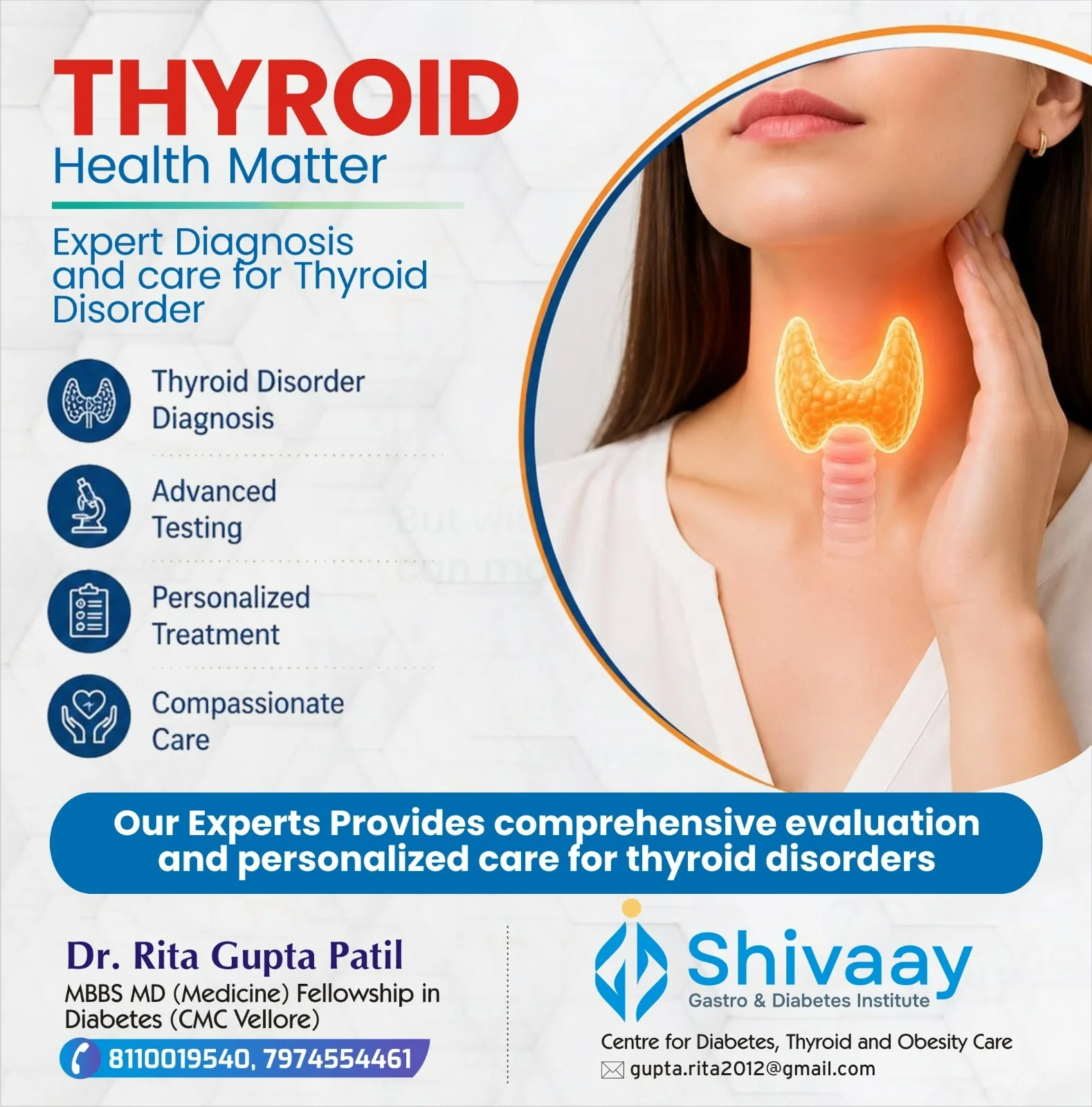
You might wonder if your thyroid needs treatment if you experience unusual tiredness, or if you notice unexpected weight changes, or if you have trouble with heat or cold. These symptoms have a wide range of causes, so it is better to have a proper examination than to guess.
If you are seeking thyroid therapy in Indore, begin with a consultation that takes into account your symptoms, medical history, test results and relevant investigations. The first step in choosing the right treatment is to find out what kind of thyroid problem you have.
Thyroid consultation is provided by Dr. Rita Gupta Patil at Shivaay Gastro & Diabetes Institute. An appointment is an opportunity to discuss the findings and understand what to do next, whether you have questions about a recent report or an existing diagnosis.
The thyroid is a small gland in the front of your neck that is shaped like a butterfly. It produces hormones that help regulate the way your body uses energy.
A thyroid condition may affect the structure of the gland, hormone production or both. An overactive thyroid produces too many hormones for the body’s needs . An underactive thyroid produces too few . Other issues are nodules, inflammation and enlargement.
Each of these disorders has different treatments. Identifying the problem's root cause will guide treatment.
Understanding the common differences among thyroid diseases can help you better communicate your concerns during a session.
Hypothyroidism can develop gradually. Symptoms may include:
• Fatigue that won’t go away.
• More sensitive to the cold.
• Weight gain.
• Dry skin or brittle hair.
• Heavy or irregular periods.
These symptoms don’t make a diagnosis on their own. Thyroid involvement can be assessed with clinical examination and blood tests.
Hyperthyroidism can lead to weight loss even if you are eating more, have a lot of sweating, shaking in the hands, trouble sleeping or an irregular or rapid heartbeat.
Some people experience an irritation or weakness of their muscles instead of a noticeable weight change. Symptoms differ and personal assessment is significant.
A lump found within the gland is called a thyroid nodule. The majority of nodules are harmless, but a doctor needs to evaluate any new lump in the neck.
Thyroid blood tests can be normal even if there is a nodule. The doctor may order more tests or monitoring, depending on the results of the ultrasound and exam.
For example, if you are seen for thyroid consultation in Indore if symptoms continue, or if a blood report needs to be interpreted, or if examination shows thyroid enlargement.
If you are on thyroid medication and have concerns about your therapy an appointment is also helpful.
What is different in practice. For example, describe how fatigue affects your work day, when you experience palpitations or how your weight has changed over the years. A short timeline can help keep the discussion on track.
Come with observations & questions, rather than a hypothesis. This lets the physician consider both thyroid and non-thyroid causes.
Thyroid problems are diagnosed by taking a medical history, doing a physical exam, and running some tests. All types of investigations are not required for all patients.
Often, a TSH test is used to check thyroid function. Measurement of free T4 and sometimes T3 gives more clear results.
Where clinically appropriate, antibody testing may assist in establishing an autoimmune etiology. When interpreting the results, the clinical status of the patient and the reference ranges used by the laboratory should be considered.
Thyroid ultrasound is a study of the structure of the thyroid and can be used to assess nodules. Not every abnormal thyroid blood test needs to be.
Some nodules may require a fine needle aspiration biopsy. Selection is based on features such as size and ultrasound appearance.
Your physician can explain the purpose of each recommended test.
When you look for thyroid care in Indore, there are many claims of treatment. During a helpful consultation you should be told which options are appropriate for your diagnosis and why.
Levothyroxine, a replacement for deficient thyroid hormone, is commonly used to treat hypothyroidism. The recommended dose is modified based on blood tests and clinical assessment. Do not stop or change the dosage of your medicine without your doctor’s approval.
You may be treated with anti-thyroid drugs, radioactive iodine or surgery. This will depend on the reason and specifics of your condition. Symptoms such as a fast heartbeat can also be treated with medication.
Benefits, restrictions, pregnancy issues and follow-up needs must all be discussed. These are general treatment options your assessment will determine what program or referral is right for you.
There are many benign nodules. Others require further assessment or treatment because of alarming results, growth, pressure symptoms or hormone production.
A nodule is not necessarily cancer or surgery.
Taking care of your thyroid usually doesn't end with the prescription you get. People often get blood tests for hypothyroidism six to eight weeks after their medication is started or the dose is changed. Your doctor will decide how often to repeat the test depending on your individual situation.
Tell your doctor if you are taking other medicines or dietary supplements such as calcium, iron and biotin as they may affect your treatment or the results of tests. Pregnancy or intention to become pregnant should also be disclosed as soon as possible.
When you leave an appointment, make sure you are clear about:
• The date of your next review.
• Any tests required in advance (if any).
• Taking prescription drugs.
• What changes should be an early contact?
• Who to contact if you have questions about therapy.
You can keep these instructions together to help you plan ongoing care.
A little preparation can maximize consultation time. Instead of trying to build out your own complete test package, bring any thyroid screening records you may have from Indore.
Some useful items:
• Past blood work on thyroid with dates.
• Current medication packing and prescriptions
• Any previous biopsy or ultrasound reports, if you have them.
• List of other therapies and supplements.
• Notes on symptoms and relevant family history.
Make a list of your biggest worries beforehand. What does this result mean? Do I need treatment now? How will we know if the plan is working?” are some of the questions you may have.
If you have diabetes or any other chronic condition, bring your treatment records so the doctor can get the full picture.
In addition, if you are searching for a thyroid doctor in Indore, then also take into account the travel convenience, credentials, communication, and follow-up plans.
Ask about how the clinic will assess your particular problem and arrange investigations. Please check location, consultation fees and appointment times before visiting.
You should leave a useful appointment knowing the working diagnosis, what questions are unanswered and what the next steps are. You should also have an opportunity to discuss your treatment preferences and practical matters, such as timing of sessions around work.
An easy follow-up process can help ensure that local patients are seen on a regular basis.
No. Weight increase can happen for a number of reasons. Hypothyroidism can be one thing to consider, but the reason needs to be determined by symptoms, examination and relevant testing.
Many patients with persistent hypothyroidism will require replacement therapy for the rest of their lives. Some transient thyroid disorders resolve. You should not decide when to stop taking medication based on your diagnosis and results of your follow-up.
Blood tests are hormone function, ultrasound is structure. No. Your doctor will suggest imaging if there is a good reason — for instance, to look at a nodule.
If the result is normal, the treatment may be working. Follow your doctor's instructions and talk this over with your doctor.
You don't have to evaluate yourself tests or symptoms. A consultation can help you learn more about your thyroid problem, and to formulate a clear plan for evaluation, treatment and review.
Personalized Thyroid Treatment Indore Book an appointment with Dr. Rita Gupta Patil at Shivaay Gastro & Diabetes Institute
Call us right now to make an appointment for your thyroid consultation!
| Tags: | #Thyroid Treatment in Indore |


